Air Freight From China
to Nigeria
Need fast, reliable air freight from China to Nigeria? We ship door-to-door from Guangzhou, Shenzhen, and Shanghai to Lagos, Abuja, and Port Harcourt. DDP clearance included — no hidden costs.
🛫 Live Route Times
What Is Air Freight From China to Nigeria?
Air freight from China to Nigeria is the fastest way to move commercial cargo by aircraft — from Chinese manufacturing cities like Guangzhou, Shenzhen, Yiwu, Shanghai, Ningbo, Foshan, and Dongguan — to Nigerian cities including Lagos, Abuja, Port Harcourt, Kano, and Enugu. Standard air freight delivers in 7 to 10 working days, while our Express service ships in 3 to 4 working days. Unlike sea freight, which takes 60 to 70 days by container, air freight is the fastest way to keep your business moving.
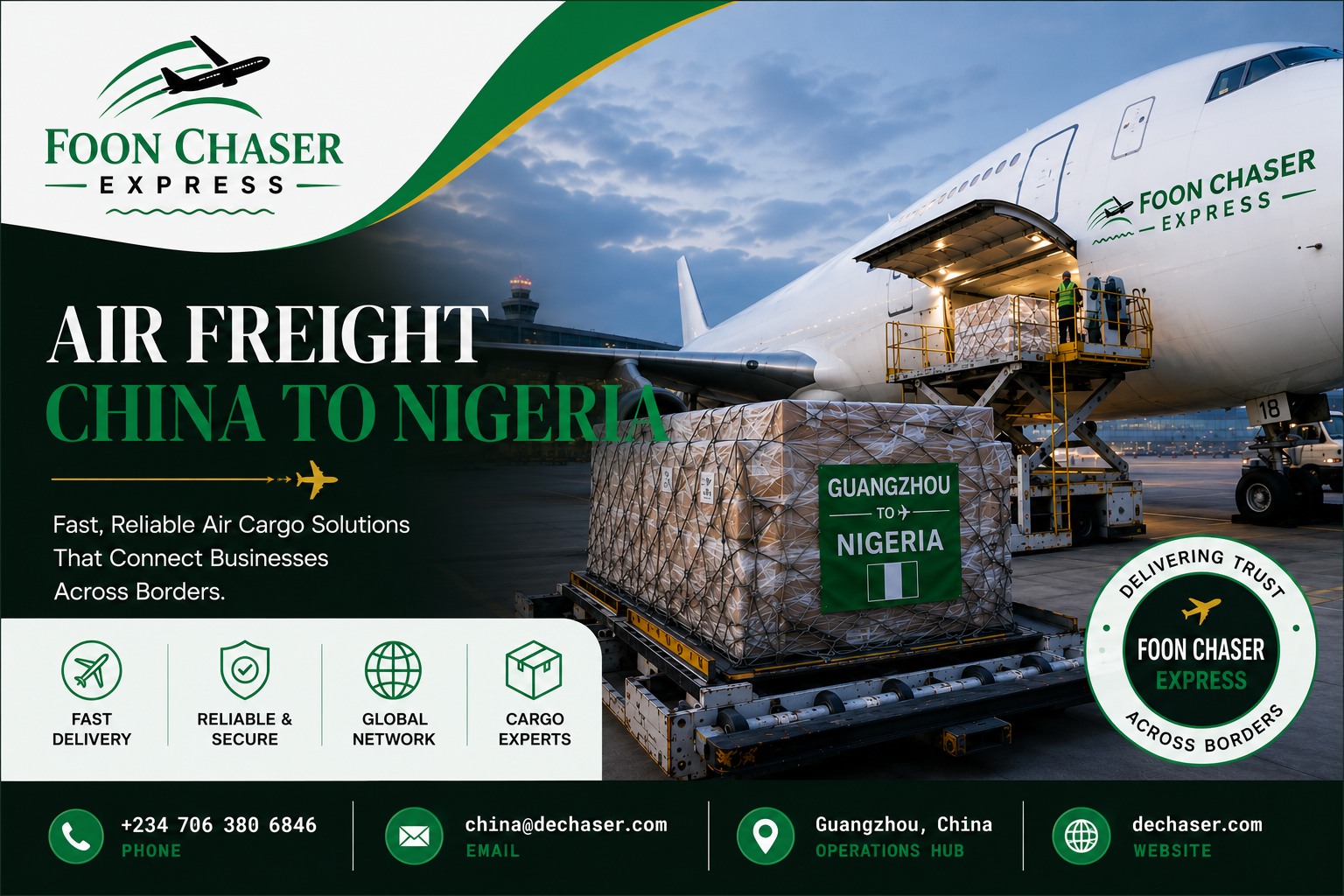
A full air freight shipment starts with your supplier handing over goods at their factory gate or a Guangzhou warehouse. The freight forwarder then collects and consolidates (if needed). Next, they prepare export documentation — including the Airway Bill (AWB) and commercial invoice. After that, they complete export customs clearance through China Customs, book cargo space on a commercial or cargo airline, and deliver the goods to Murtala Muhammed International Airport (MMIA) in Lagos or another Nigerian airport. On arrival, the shipment goes through Nigeria Customs Service (NCS) inspection and duty assessment. After clearance, it is delivered to your address.
Who Uses Air Freight From China to Nigeria?
Electronics Importers
Phones, tablets, accessories, and components where fast restocking protects sales revenue and avoids stockouts ahead of peak seasons.
Solar & Energy Companies
Inverters, panels, and battery systems that are high in value, time-sensitive for project deadlines, and risky if delayed at sea for weeks.
Fashion & Retail
Clothing, shoes, accessories, and seasonal collections that need to arrive before trends shift or festive demand peaks.
Machinery Parts
Replacement parts for production equipment where every day of downtime costs more than express air freight.
Product Samples
Pre-production samples for quality checks, market testing, or trade fair presentations that must arrive within days.
Medical & Pharma
Medical devices and pharmaceutical raw materials where NAFDAC approvals and urgency make sea freight impractical.
When Does Air Freight From China to Nigeria Make Sense?
Use air freight when: your goods weigh under 500kg, you need delivery in under 25 days, your goods have a high value-to-weight ratio (electronics, fashion), or you face an urgent restocking emergency. For heavy bulk cargo over 1,000kg, sea freight from China to Nigeria at USD 495/CBM is typically more economical. Learn more in our complete guide to shipping from China to Nigeria.
Get a Personalised Air Freight Quote
Fill in your cargo details below and click Send via WhatsApp. Your message will be pre-filled with all the info you entered, ready for our team to respond with a complete quote.
Air Freight Cost From China to Nigeria
Air freight pricing from China to Nigeria in 2026 is calculated per chargeable kilogram — the greater of actual weight and volumetric weight. See the calculator below for the full formula. All rates below are converted using DECHASER’s approved China exchange rate, not the Nigerian parallel (black market) rate.
Office Pickup (20kg+)
- Pickup at our China office
- China export customs
- Full airline booking
- 7 to 10 working days transit
- Nigeria customs clearance
Door-to-Door Lagos
- Factory/warehouse pickup in China
- China export customs
- Full airline booking
- Nigeria customs DDP clearance
- Delivery to your door in Lagos
- 7 to 10 working days
Express Delivery (20kg+)
- Courier-grade speed
- 3 to 4 working days transit
- Priority airline booking
- Express customs handling
- Door-to-door delivery
Detailed Air Freight Rate Sheet (2026)
Current published rates for all shipment sizes and service tiers. All rates include the freight component and customs clearance component as separate line items.
| Service / Weight | Freight (USD/kg) | Customs Clearance (₦/kg) | Transit Time |
|---|---|---|---|
| ⚡ EXPRESS DELIVERY (Minimum 20kg) | |||
| Express Delivery (20kg+) | $18.98 | ₦2,500 | 3 to 4 working days |
| 📦 SHIPMENTS BELOW 20KG (Normal Goods) | |||
| 1 to 10 kg | $20.50 | ₦1,500 | 7 to 10 working days |
| 11 to 15 kg | $20.50 | ₦1,500 | 7 to 10 working days |
| 16 to 19 kg | $16.98 | ₦1,500 | 7 to 10 working days |
| 📦 SHIPMENTS OF 20KG & ABOVE (Normal Goods) | |||
| Office Pickup | $12.90 | ₦1,500 | 7 to 10 working days |
| Door-to-Door Delivery Within Lagos | $14.88 | ₦1,500 | 7 to 10 working days |
| Delivery to Other States | $16.58 | ₦1,500 | 7 to 10 working days |
* All rates quoted in USD/kg for the freight component plus ₦/kg for the Nigeria customs clearance component. Rates are converted using DECHASER’s approved China exchange rate. For shipments under 20kg, the highest applicable rate band applies.
What Affects Air Freight Cost From China to Nigeria?
Chargeable Weight
The higher of actual vs volumetric weight. Bulky light goods pay volumetric rates. Heavy dense goods pay actual weight.
Origin City
Guangzhou and Shenzhen have the most competitive rates due to high cargo volume. Yiwu, Ningbo, and Hong Kong can be slightly higher.
Transit Speed
Express (3 to 4 days) vs standard (7 to 10 days) vs battery (15 to 25 days). Express is the fastest but most expensive per kg.
Customs Terms (Incoterms)
DDP (all-inclusive) costs more upfront but eliminates surprise duty bills. DDU transfers customs risk to you on arrival.
Fuel Surcharge (FSC)
Airlines adjust fuel surcharges monthly. In 2026, FSC for China-Africa routes ranges from $0.40 to $0.90/kg depending on oil prices.
Cargo Type & Restrictions
Lithium batteries, hazardous materials, and oversized items incur surcharges. NAFDAC-regulated goods need additional documentation.
Hidden Costs to Watch in Air Freight From China to Nigeria
Hidden cost warning: Many forwarders quote “airport-to-airport” rates that exclude Nigerian import duty (typically 5 to 35% of CIF value), MMIA handling charges, NPA levies, and last-mile delivery. To avoid surprises, always ask for an all-in DDP price to know your true landed cost. Our ₦1,500/kg (or ₦2,500/kg for Express) customs clearance component already accounts for the standard NCS handling, but additional customs duties and government charges are payable by the customer unless otherwise agreed. See our Nigeria import duty calculator. You can also verify official tariff classifications through the Nigeria Customs Tariff portal.
Air Freight From China to Nigeria: Transit Times
Transit times depend on three key factors: the cargo type (normal, express, or battery), the origin city in China, and the routing (direct vs connecting flights). The table below reflects 2026 average performance for air freight services — based on IATA cargo tracking standards.

| Service Type | Origin (China) | Destination | Transit Time | Notes |
|---|---|---|---|---|
| ✅ Normal Cargo | Guangzhou, Shenzhen, Shanghai, Yiwu, Ningbo | Lagos / Abuja / PH | 7 to 10 working days | Standard DDP service, all rates in main rate sheet |
| ⚡ Express Service | Guangzhou / Shenzhen | Lagos / Abuja / PH | 3 to 4 working days | Min 20kg, USD 18.98/kg + ₦2,500/kg |
| 🔋 Battery Cargo | Guangzhou, Shenzhen, Shanghai, Yiwu | Lagos / Abuja / PH | 15 to 25 working days | IATA DG declaration required, longer handling |
| 🇭🇰 Hong Kong Shipments | Hong Kong | Lagos / Abuja / PH | 15 to 25 working days | USD 15.00/kg, additional routing time |
| 🛃 Nigeria Customs (variable) | All | All | 1 to 5 working days | Document completeness drives clearance time |
What Affects Air Freight Transit Time?
The biggest variable is Nigeria Customs clearance. A shipment arriving at MMIA can sit for 1 to 5 additional days if documentation is incomplete. Similarly, if the Form M is not properly linked, or the NCS selects cargo for physical examination, delays follow. Our Nigeria customs clearance service handles pre-arrival documentation to minimise all such risks. Other factors include:
- Cargo type: Normal cargo clears faster than battery cargo (15 to 25 days) because dangerous goods require additional handling, IATA DG documentation, and dedicated cargo space.
- Service tier: Express delivery (3 to 4 days) is prioritised on the next available flight. Standard service (7 to 10 days) consolidates with other shipments for the best value.
- Flight availability: Guangzhou has daily cargo connections to Lagos. Smaller origin cities may have only 3 to 4 weekly departures.
- Consolidation delays: When your shipment is consolidated with others, the whole batch waits until a full load is assembled. As a result, smaller shipments can experience extra waiting time.
- Public holidays: Chinese Golden Week (October), Spring Festival (January/February), and Nigerian public holidays each add 2 to 5 days to transit.
Sea Freight Rates From China to Nigeria (Including Customs Clearance)
For heavy bulk cargo, sea freight from China to Nigeria remains the most cost-effective option. Our published rates are charged per CBM (Cubic Meter) and include both the ocean freight and the Nigeria customs clearance component — so you see the full cost upfront.
| Cargo Type | Rate (USD per CBM) | Inclusions | Estimated Transit Time |
|---|---|---|---|
| 📦 Normal Cargo | USD 495 / CBM | Ocean freight + Nigeria customs clearance | 60 to 70 days |
| 🔋 Battery Cargo | USD 545 / CBM | Ocean freight + Nigeria customs clearance (DG surcharge) | 60 to 70 days |
Sea freight rates are quoted in USD per cubic meter (CBM). One CBM equals approximately 1,000 kg by weight or 1 m³ by volume, whichever is greater. Battery cargo carries a USD 50/CBM DG surcharge due to dangerous goods handling and segregation requirements on vessels. All rates are converted using DECHASER’s approved China exchange rate.
When to choose sea freight: Sea freight is the right choice for shipments over 1,000 kg or 5 CBM, where the 60 to 70 day transit is acceptable. For most bulk cargo — furniture, tiles, machinery, large electronics orders, building materials — the per-kg cost saving is significant compared to air freight. Our team can quote you both air and sea for the same cargo so you can make an informed decision.
Special Cargo Air Freight Rates From China to Nigeria
Some cargo types have dedicated pricing because of the unique handling, documentation, or pricing structure they require. Below are our current 2026 rates for the most common special cargo categories shipped by air from China to Nigeria.
| Cargo Type | Freight (USD) | Customs Clearance (₦/kg) | Transit Time |
|---|---|---|---|
| 😷 NOSE MASKS | |||
| Nose Masks (per kg) | $15.90 / kg | ₦1,500 / kg | 7 to 10 working days |
| 📱 INDIVIDUAL ITEMS (per piece) | |||
| Phone | $30 each | — | 7 to 10 working days |
| Laptop | $100 each | — | 7 to 10 working days |
| 🇭🇰 HONG KONG SHIPMENTS | |||
| Hong Kong Shipments (per kg) | $15.00 / kg | ₦1,500 / kg | 15 to 25 working days |
| 🔋 BATTERY CARGO | |||
| Battery Cargo (per kg) | $15.50 / kg | ₦1,500 / kg | 15 to 25 working days |
Phone and laptop per-piece rates apply to single-unit shipments and small parcels. For bulk quantities of phones or laptops, the standard per-kg rate (20kg+ band) usually offers better value. All special cargo rates are converted using DECHASER’s approved China exchange rate.
Hong Kong route note: Hong Kong-routed shipments take 15 to 25 working days due to additional transit handling. Ensure your cargo is not on our restricted items list — most cosmetics, liquids, and certain personal items can only be shipped from Hong Kong with prior approval.
Restricted & Prohibited Items
To protect your shipment and ensure compliance with airline safety regulations, Nigeria Customs requirements, and our own operational policies, Foon Chaser Express Limited does NOT accept the following items for air freight from China to Nigeria:
🚁 Drones
All consumer and commercial drone units, regardless of size or battery capacity.
🚲 Balance Bikes
Self-balancing scooters, hoverboards, and electric balance bikes (battery restriction).
💆 Massage Chairs
Full-size electric massage chairs and similar heavy electrical furniture items.
🚗 Children’s Remote-Control Cars
Battery-powered children’s ride-on toys and remote-control vehicles.
💨 Sprays & Pressurised Gas Canisters
Aerosol cans, spray paints, deodorant sprays, and any pressurised gas containers.
💧 Liquids
All liquid products in commercial quantities (small sealed retail items may be reviewed case-by-case).
🧂 Powders
Loose powders including protein powders, cosmetics powders, and similar bulk powder products.
💊 Medicines
Pharmaceuticals without NAFDAC pre-approval and proper documentation.
🍔 Food Items
Perishable foods, fresh produce, and unprocessed food items requiring NAFDAC approval.
💄 Cosmetics
All cosmetics except approved Hong Kong shipments with proper documentation.
🎨 Paint
All liquid paints, varnishes, thinners, and related chemical products.
⛽ Gasoline & Flammable Materials
Gasoline, fuel, lighter fluid, and any flammable liquid or gas products.
🧴 Glue & Hazardous Items
Industrial glues, adhesives, and similar hazardous chemical products.
⚠ IMPORTANT NOTICE: If restricted items are shipped and become stranded in Hong Kong or any transit location due to customs regulations, FOON CHASER EXPRESS LIMITED will not be responsible for any delays, penalties, storage charges, confiscation, or losses arising from such shipments. Please confirm your cargo is allowed before sending it to our China warehouse. When in doubt, contact us first via WhatsApp or email to verify.
How Air Freight From China to Nigeria Works
Here is the exact process Foon Chaser Express follows for every air freight shipment. It runs from supplier pickup in China to final delivery at your warehouse or shop in Nigeria.
Steps 1 to 4: Pickup, Documentation, and Departure From China
Supplier Pickup & Consolidation (China)
Our Guangzhou operations team collects goods directly from your supplier’s factory or warehouse. Coverage spans Guangzhou, Shenzhen, Foshan, Dongguan, Yiwu, and other manufacturing hubs. Multiple suppliers’ goods are then consolidated at our bonded warehouse. Consequently, you save on separate freight minimums.
Quality Inspection & Documentation
We verify carton count, labels, and packaging integrity. At the same time, we prepare the commercial invoice, packing list, Airway Bill (AWB), and any required certificates. These include SONCAP (for regulated products) and manufacturer’s declarations for battery shipments. Poor documentation is the number one cause of customs delays — therefore, we get it right the first time.
China Export Customs Clearance
Cargo is declared through China Customs with accurate HS Codes. China’s General Administration of Customs requires correct commodity declarations and export licences for restricted goods. Our licensed customs brokers in Guangzhou handle this daily. As a result, there are zero hold-ups at China’s exit ports.
Airline Booking & Cargo Handling
We book space on commercial cargo airlines flying from Guangzhou Baiyun (CAN), Shenzhen Bao’an (SZX), or Shanghai Pudong (PVG) to Lagos MMIA (LOS). Cargo is handed over to the airline’s cargo terminal, weighed, and dimensioned. The chargeable weight is then confirmed. You receive the Master Airway Bill (MAWB) for independent tracking.
Steps 5 to 7: Transit, Nigeria Customs, and Final Delivery
Flight Transit
Most Guangzhou to Lagos flights are routed via a Middle East hub — Doha, Dubai, Addis Ababa, or Nairobi. Direct flights are rare on this route. Flight time is typically 12 to 18 hours. However, total transit also includes loading and offloading time at transit airports.
Nigeria Customs Clearance (NCS / MMIA)
On arrival at MMIA, cargo enters the Nigeria Customs Service’s control. Our Lagos clearing agents file your Single Goods Declaration (SGD) using the NICIS II system. For DDP shipments, we handle import duty payment, VAT, and any levies. Products requiring NAFDAC or SON approvals are coordinated accordingly. The Pre-Arrival Assessment Report (PAAR) is also obtained via the Destination Inspection system for applicable goods.
Final Delivery in Nigeria
Once released by NCS, goods are loaded onto our delivery vehicles. Lagos deliveries typically happen same-day or next-day after customs release. For Abuja, Kano, Port Harcourt, and Enugu, we coordinate with our inland network. You then receive confirmation and a delivery receipt.
Pro tip: For faster customs clearance, ensure your supplier provides a detailed commercial invoice with unit prices, HS codes, and country of origin. Vague descriptions like “goods” or “samples” trigger manual inspection, adding days. See our Nigeria customs clearance guide for full documentation requirements.
Chargeable Weight: The Key to Understanding Air Freight Costs
If you’ve ever received an air freight invoice higher than expected, chargeable weight is usually the reason. Airlines don’t simply charge for how heavy your goods are. Instead, they also charge for the physical space those goods occupy on the aircraft. The industry follows IATA chargeable weight guidelines. Here’s exactly how it works.

The Formula
÷ 6,000 = vol. kg
The 6,000 divisor is the standard IATA air freight conversion. However, some couriers — DHL and FedEx — use 5,000, which makes them even more expensive for light bulky goods.
This is why electronics and fashion tend to cost more to air-ship relative to their actual weight. Their packaging is bulky, so volumetric rates apply. In contrast, dense heavy goods like machinery parts pay actual weight.
Real Calculation Examples
5 cartons of phone accessories
Each: 60×50×40 cm, 8 kg actual
- Vol. weight per box: (60×50×40) ÷ 6000 = 20 kg
- Total actual weight: 5 × 8 = 40 kg
- Total volumetric: 5 × 20 = 100 kg
- Chargeable weight: 100 kg (volumetric wins)
- At $14.88/kg DDP Lagos: Total = $1,488
2 crates of steel components
Each: 80×60×30 cm, 70 kg actual
- Vol. weight per crate: (80×60×30) ÷ 6000 = 24 kg
- Total actual weight: 2 × 70 = 140 kg
- Total volumetric: 2 × 24 = 48 kg
- Chargeable weight: 140 kg (actual weight wins)
- At $12.90/kg DDP Office Pickup: Total = $1,806
Interactive Weight Calculator
Enter your cargo dimensions and weight to estimate chargeable weight and cost:
Estimate only. Final rates depend on airline, fuel surcharge, and cargo type. Send these results to our team for a binding quote.
What Can You Air Freight From China to Nigeria?
Approved Cargo Types for Air Freight From China to Nigeria
📱 Electronics & Mobile Phones
Smartphones, tablets, laptops, chargers, earphones, and accessories. High-value electronics are ideal for air freight — the cost of air is justified by eliminating the risk of 60 to 70 days at sea. Ensure proper packaging and declare accurate values for Nigeria Customs. Phones ship at USD 30 each; laptops at USD 100 each.
☀️ Solar Equipment & Inverters
Solar panels, inverter systems, charge controllers, and mounting hardware. These are high-value, project-critical items. Air freight ensures your installation timeline stays on track. Note: lithium battery components attract the battery cargo rate (USD 15.50/kg, 15 to 25 working days) and require IATA DG documentation.
👗 Fashion, Clothing & Footwear
Clothing, shoes, bags, and accessories sourced from Guangzhou Baima market, Shenzhen, or Yiwu wholesale markets. Fashion is time-sensitive — seasonal collections that miss their window lose 40 to 60% of their value at discounted sale prices.
⚙️ Machinery Spare Parts
Replacement parts for factory equipment, generators, or vehicles. When a production line is down, $500/day in air freight beats $15,000/day in lost production. We classify parts correctly to avoid Nigerian import duty surprises.
🧪 Product Samples
Pre-production samples for quality approval or trade fair display. Fast 3 to 5 day delivery via Express keeps your product development timeline intact. We handle single-piece and small-batch sample shipments efficiently.
😷 Nose Masks & PPE
Bulk nose masks and personal protective equipment shipped at our dedicated USD 15.90/kg + ₦1,500/kg rate with 7 to 10 working day transit. Ideal for healthcare distributors and resellers.
🏗️ Construction Materials & Fittings
Specialty fittings, electrical components, and hardware for commercial projects. Ideal when project delays cost more than the premium air freight rate.
🧴 Cosmetics (Hong Kong Approved Only)
Skincare, haircare, and beauty goods sourced from Hong Kong-approved cosmetics suppliers. NAFDAC registration and proper labelling required for commercial importation to Nigeria. Note: cosmetics outside of approved Hong Kong routes are on our restricted items list.
Battery Shipments: What You Need to Know
Lithium-ion batteries — found in phones, laptops, power banks, and solar storage — are classified as dangerous goods (DG) under IATA Dangerous Goods Regulations. Battery cargo ships at USD 15.50/kg + ₦1,500/kg with a transit time of 15 to 25 working days due to the additional handling requirements. Specific conditions apply:
- Batteries inside equipment (e.g. assembled phones): typically allowed as Class 9 DG with declaration
- Batteries alone/loose (power banks, spare batteries): state-of-charge must be ≤30%, properly packaged
- Large lithium batteries >300Wh (EV batteries, large UPS): require full IATA DG documentation and cargo-only aircraft
- All battery shipments require a Shipper’s Declaration for Dangerous Goods
Important: Improperly declared battery shipments are confiscated and destroyed at Chinese export customs or at MMIA. Always disclose battery content upfront. We handle DG compliance routinely — just tell us what you’re shipping.
Restricted & Prohibited Cargo
For the full list of items we cannot accept, see our Restricted Items section above. Highlights include drones, balance bikes, massage chairs, RC cars, sprays, liquids, powders, medicines, food items, most cosmetics, paint, gasoline, and glue. The full notice and disclaimer are available in that section.
Key Policies & Customer Notices
Before you ship, please review the following policies. They protect your shipment, ensure smooth customs clearance, and keep our service quality consistent for every customer.
💰 Customs Duties & Government Charges
Unless otherwise agreed, customers are responsible for the payment of any customs duties, import taxes, inspections, levies, subscriptions, or other charges imposed by government agencies in the destination country. These are separate from our freight and customs clearance fees and are determined by Nigeria Customs based on your cargo’s HS code and declared value. For DDP shipments where we agree to cover these, we itemise the duty amount upfront in your quote. For DDU/DAP shipments, you settle these charges directly with Nigeria Customs on or before cargo release.
💱 Exchange Rate Policy
All freight charges are converted using DECHASER’s approved China exchange rate, not the Nigerian parallel (black market) exchange rate. This ensures transparent, consistent, and verifiable pricing on every shipment. Our approved rate is updated periodically to reflect legitimate interbank movements. The rate applied to your shipment is stated in your quote and is locked once you accept the quote and confirm the booking — protecting you from mid-shipment currency fluctuations.
📦 Tracking Number Requirement
Once your package has been sent to our warehouse address in China, you must share the tracking number with us immediately for reference and shipment monitoring. This helps us identify, receive, and process your cargo without delay. Send your tracking number via WhatsApp (+234 706 380 6846) or email (china@dechaser.com) as soon as your supplier dispatches the goods. Without the tracking number, we cannot pre-register your cargo in our consolidation system, and this may delay your shipment by several days while we manually identify the package at the warehouse.
📝 Before You Ship — Complete the Online Booking Form
To ensure smooth processing of your shipment, kindly complete our online booking form before sending your cargo. Use the quote form on this page to register your shipment, declare your cargo type, weight, and dimensions, and provide your delivery address. Booking in advance allows us to pre-allocate cargo space, prepare the right documentation templates, advise you on any special requirements (such as SONCAP for electronics or DG declarations for batteries), and give you an accurate transit estimate. Shipments sent to our China warehouse without a prior booking may experience additional handling delays and may be subject to a surcharge for unannounced cargo.
DDP Air Freight From China to Nigeria: How It Works
DDP — Delivered Duty Paid — is the most comprehensive Incoterm available for air freight from China to Nigeria. When you ship DDP, Foon Chaser Express assumes full responsibility. This covers everything from your supplier’s door in China to your door in Nigeria. It includes all import duties, VAT, NCS fees, and local delivery charges. Consequently, you pay one agreed price and we handle everything else.

Why Choose DDP?
- No surprise customs bills on arrival
- Fixed, predictable landed cost
- No need to deal with NCS agents
- No risk of goods held at MMIA
- Faster clearance (pre-arranged)
- One point of contact end-to-end
What’s Included in DDP?
- Factory/warehouse pickup in China
- China export customs clearance
- Air freight (all surcharges)
- Nigeria customs clearance (₦1,500/kg or ₦2,500/kg for Express)
- MMIA handling & inspection
- Last-mile delivery in Nigeria
DDP vs DDU Comparison
- DDP: All costs upfront, zero surprises
- DDU: You pay duty on arrival
- DDU risk: Duty demands delay clearance
- DDP is best for: First-time importers
- High-volume veterans may prefer DDU
Form M requirement: Nigerian importers bringing in goods above $500 in value must open a Form M through a Nigerian bank before the goods are shipped. Our team advises on Form M requirements and works with your bank to ensure documentation is correctly linked. Without this step, CBN-related clearance blocks can delay your shipment significantly. Learn more on our dedicated Form M Nigeria guide.
Air Freight vs Sea Freight From China to Nigeria
Choosing between air and sea freight from China to Nigeria is one of the most important decisions for Nigerian importers. Both options have their place. However, the key is matching the method to your specific cargo, timeline, and cash flow situation. Use our sea freight rate sheet above and our sea freight from China to Nigeria guide for a deeper breakdown of the ocean option.

Side-by-Side Comparison: Air Freight vs Sea Freight
| Factor | ✈ Air Freight | 🚢 Sea Freight |
|---|---|---|
| Transit Time | 3 to 25 working days | 60 to 70 days |
| Cost per kg (Normal Cargo) | $12.90 to $18.98/kg | From USD 495/CBM (≈ $0.50/kg+) |
| Minimum Shipment | 1 kg (sub-20kg at higher band) | Any CBM (LCL) |
| Ideal Weight Range | Under 500 kg | Over 500 kg / all sizes |
| Risk of Damage | Very low | Low to medium (moisture, port handling) |
| Customs Complexity | Medium | High (Form M mandatory, more documents) |
| Cost Predictability | High (DDP fixed) | Medium (destination charges variable) |
| Battery Cargo | $15.50/kg, 15 to 25 days | USD 545/CBM, 60 to 70 days |
| Best For | Electronics, fashion, urgency, samples | Bulk cargo, heavy machinery, furniture |
| Carbon Footprint | High | Lower per kg |
| Recommended by Weight | Under 300 kg strongly preferred | Over 1,000 kg strongly preferred |
Decision Guide: Which Should You Choose?
Choose Air Freight If:
- Shipment is under 300 to 500 kg
- Goods are high value (phones, electronics)
- You need goods in under 25 days
- Stock emergency / urgent restocking
- Seasonal goods with short selling window
- First shipment (lower risk)
Choose Sea Freight If:
- Shipment is over 500 to 1,000 kg
- Goods are low value per kg (furniture, tiles)
- You can wait 60 to 70 days
- Buying a full container (FCL)
- Liquids, hazardous goods (complex for air)
Use Both When:
- Split shipments (urgent + bulk)
- Air first batch for market testing
- Sea regular stock + air for fast replenishment
- High-value + low-value items in one order
Real Air Freight From China to Nigeria: Case Studies
These scenarios are based on typical client situations handled by Foon Chaser Express from our Guangzhou hub.
How Nigerian Importers Use Air Freight From China to Nigeria
Solution: Foon Chaser collected goods from the Shenzhen supplier within 24 hours, then consolidated them with one other consignee to reach the minimum weight threshold. We subsequently booked the next available cargo flight. The SONCAP certificate was pre-arranged; Nigeria customs DDP clearance completed in 1.5 days on arrival. Goods were delivered to Alaba International Market on day 8.
Outcome: The client sold the entire stock within 3 weeks at full Christmas pricing, recovering the premium air freight cost within the first day of sales. They now use air freight for all urgent restocks and sea freight at USD 495/CBM for forward-planning bulk orders.
Solution: Our Guangzhou team coordinated DG classification with the manufacturer and secured the Shipper’s Declaration for Dangerous Goods. We then booked a cargo-only aircraft section. Form M was already in place through the client’s bank. Nigeria Customs DDP clearance at MMIA took 2 days. Subsequently, road delivery to Abuja was completed on day 20.
Outcome: Project deadline met. Contract penalty avoided. The cost difference between air freight (~$5,425) and the penalty exposure (₦16M+ ≈ $10,000) made the decision straightforward. Learn more about our DDP shipping service.
Challenge: Fashion packaging is extremely volumetric — 120 kg actual weight, 190 kg chargeable. The client initially refused, believing they could find a cheaper option through an informal agent. That agent quoted $8/kg but excluded Nigerian customs duty (15% on fashion) and MMIA handling, which added $600 to the real cost.
Outcome: Our all-in DDP quote turned out ₦400,000 cheaper than the informal agent’s hidden-cost shipment. The collection arrived 7 days before Eid and sold out within the first week. As a result, the client now books with us for every seasonal collection. See our full Guangzhou to Nigeria shipping service.
Air Freight From China to Nigeria: Common Questions Answered
Costs, Timing, and Regulations for Air Freight From China to Nigeria
Air Freight From China to Nigeria: Frequently Asked Questions
Most airlines set a minimum of 45 to 100 kg for regular air freight. For smaller shipments (under 20kg), our published rates for the 1 to 10 kg and 16 to 19 kg bands apply. We can consolidate your goods with others to reach the 20kg+ lower rate band if needed, reducing your per-kg cost.
Use the quote form on this page (it opens WhatsApp with your details pre-filled), email china@dechaser.com with your cargo details, or call +234 706 380 6846. We respond with a binding DDP quote within 2 to 4 working hours during Guangzhou business hours (UTC+8). All quotes are converted using DECHASER’s approved China exchange rate.
Yes. The CBN Form M is mandatory for all commercial imports to Nigeria valued above $500, regardless of freight mode. Specifically, it must be opened at your Nigerian bank before the goods are shipped. Failure to have a Form M at time of arrival results in cargo being detained. Our team advises on the exact Form M requirements based on your shipment details.
PAAR (Pre-Arrival Assessment Report) is a Nigerian Customs document generated by Destination Inspection agents before cargo arrives. It is required for most commercial imports subject to Destination Inspection (DI). Our clearing agents generate the PAAR based on your commercial invoice and other shipping documents as soon as the AWB is confirmed.
Yes. Our Guangzhou operations team handles multi-supplier consolidation as a standard service. We collect from different factories across Guangzhou, Shenzhen, Foshan, Dongguan, and surrounding cities, consolidate at our warehouse, and ship as a single consignment. This saves you multiple air freight minimums.
Nigerian import duty is assessed on the CIF (Cost + Insurance + Freight) value of the goods at the applicable tariff rate for the HS Code. Electronics typically attract 5 to 20%, clothing 15 to 25%, and machinery parts 5 to 10%. Additionally, a 7.5% VAT and a 1% CISS (Comprehensive Import Supervision Scheme) levy apply. Unless otherwise agreed, customers are responsible for the payment of all customs duties and government charges. For DDP shipments, we calculate all these upfront so you know your exact landed cost.
For DDP shipments, we handle this entirely on your behalf. Common causes of holds include: incomplete commercial invoice, missing SONCAP/NAFDAC documentation, or underdeclared values. Our clearing agents are physically present at MMIA cargo sheds and address queries immediately. In most cases, holds are resolved within 24 to 48 hours for clients with proper documentation.
Technically yes, but it is rarely economical. Furniture is bulky with high volumetric weight, meaning the air freight cost often exceeds the value of the goods. Sea freight at USD 495/CBM is almost always the better choice for furniture. We recommend air only for small, high-value furniture pieces or urgent interior design project items.
LCL (Less than Container Load) combines your goods with others in a shared container — ideal for smaller shipments billed at our published USD 495/CBM rate. FCL (Full Container Load) gives you a dedicated 20ft or 40ft container. This is relevant if you are comparing air vs sea options — our sea freight rate sheet explains both fully.
Red flags include: unusually low rates (below the published USD 12.90/kg office pickup rate for normal cargo), agents who refuse to provide an official AWB number, requests for full upfront payment to personal accounts, and “handling fees” demanded after goods arrive. Verify: physical China office address, company registration, and ability to provide the MAWB before full payment. Foon Chaser provides all documentation transparently.
We operate from Guangzhou as our primary hub but cover all major Guangdong Province cities including Shenzhen, Foshan, Dongguan, Zhongshan, and Huizhou. We also coordinate pickups from Shanghai, Ningbo, Yiwu, and Hong Kong (Hong Kong-routed shipments ship at USD 15.00/kg with 15 to 25 working days transit), typically consolidating goods at our Guangzhou warehouse before airlifting.
Yes. We arrange all-risk cargo insurance at approximately 0.3 to 0.5% of the declared cargo value. Given that air freight losses are rare but do occur (damaged electronics, theft at transit hubs), insurance is strongly recommended for high-value shipments over $5,000. Simply request this when you get your quote.
Airlines publish monthly fuel surcharges (FSC) based on jet fuel prices. In 2026, FSC for China-Africa routes is typically $0.40 to $0.90/kg, added on top of the base freight rate. Our DDP quotes always include current FSC so you see the real all-in cost. Global oil price volatility has kept surcharges moderate compared to the 2022 spikes. All FSC is calculated using DECHASER’s approved China exchange rate.
We accept wire transfer (USD, CNY, NGN), and can discuss payment terms for regular clients. For new clients, we typically require a 50 to 70% deposit before cargo collection, with the balance before delivery. We never request personal mobile money payments — all transactions go through official company bank accounts. All USD amounts are converted using DECHASER’s approved China exchange rate.
Yes. We deliver to all major Nigerian cities at our “Other States” rate of USD 16.58/kg + ₦1,500/kg. Abuja, Port Harcourt, Kano, Ibadan, Enugu, and Benin City are covered through our inland transport network. Delivery beyond Lagos typically adds 1 to 3 business days and a local transport cost which we include in your DDP quote upfront.
SONCAP (Standards Organisation of Nigeria Conformity Assessment Programme) is a mandatory pre-shipment inspection certificate for regulated goods — primarily electronics, electrical equipment, and certain machinery. It must be obtained in China before export. Our Guangzhou team works with SON-approved inspectors to arrange SONCAP for your shipment. See our dedicated SONCAP guide.
The Airway Bill (AWB) is the air cargo equivalent of a Bill of Lading. It is a non-negotiable transport document that serves as the contract of carriage, cargo receipt, and customs declaration. The Master AWB (MAWB) is issued by the airline; the House AWB (HAWB) is issued by your freight forwarder. You use it to track your shipment and clear customs.
We handle DDP (Delivered Duty Paid), DDU/DAP (Delivered at Place), FOB (Free on Board, where you take over freight responsibility), and CIF (Cost, Insurance, Freight). Most Nigerian importers benefit most from DDP — one price, no surprises. FOB and CIF are for experienced importers who have their own clearing agents in Nigeria. Note that for DDP shipments, unless otherwise agreed, customers remain responsible for the underlying government charges — we pay them on your behalf and itemise them in your invoice.
That is exactly what we are here for. Our Guangzhou operations team communicates directly with your Chinese suppliers in Mandarin, coordinates pickups, inspects goods, and handles all Chinese-language documentation. You communicate with us in English. We bridge the language and operational gap between China manufacturing and Nigerian business needs.
In 2026, air cargo rates on the China-Africa corridor have stabilised after the post-pandemic volatility. Capacity has increased as more carriers added belly cargo capacity on long-haul routes. Meanwhile, fuel surcharges have remained moderate, and Nigeria Customs has improved digital processing through NICIS II — reducing clearance times. Key variables to watch include global oil prices affecting FSC, Chinese export peak seasons (Q3 to Q4), and any CBN/NCS policy changes affecting import requirements. Our published 2026 rate sheet — USD 12.90 to 18.98/kg normal cargo, USD 15.50/kg battery cargo, USD 15.00/kg Hong Kong — applies across the year.
Once your package has been sent to our warehouse address in China, you must share the tracking number with us immediately for reference and shipment monitoring. This helps us identify, receive, and process your cargo without delay. Without the tracking number, your cargo may sit unprocessed at our warehouse for several days while our team manually identifies it — which delays your shipment and can push you into a later consolidation batch.
All freight charges are converted using DECHASER’s approved China exchange rate, not the Nigerian parallel (black market) exchange rate. This ensures transparent, consistent, and verifiable pricing on every shipment. The rate applied to your booking is stated in your quote and locked once you confirm — protecting you from mid-shipment currency volatility.
Unless otherwise agreed, customers are responsible for the payment of any customs duties, import taxes, inspections, levies, subscriptions, or other charges imposed by government agencies in the destination country. These are determined by Nigeria Customs based on your cargo’s HS code and declared CIF value. For DDP shipments, we pay these on your behalf and itemise the amount in your quote; for DDU/DAP, you settle them directly with Nigeria Customs before cargo release.
Yes. To ensure smooth processing of your shipment, kindly complete our online booking form before sending your cargo. This allows us to pre-register your shipment in our system, assign the correct service tier (Normal, Express, Battery, Sea, Special Cargo), and prepare the right documentation templates in advance. Shipments that arrive at our China warehouse without a prior booking may experience additional handling delays and may be subject to a surcharge for unannounced cargo.
📘 Looking for the complete picture? Read our definitive Shipping From China to Nigeria guide — costs, transit times, customs, DDP, and all shipping methods in one place.
Compare Air Freight From China to Nigeria for Your Shipment
Not sure whether air or sea is right for your cargo? Send us your shipment details — weight, dimensions, timeline, and cargo type. We will then give you a comparison quote for both services, along with honest advice on the best option for your needs.
Every Day Without Stock
Is Revenue You Are Losing
Nigerian importers who delay booking air freight from China to Nigeria face a predictable chain of problems. Stockouts lead to lost customers, who then go to your competitor. Furthermore, hidden customs costs on poorly planned shipments can destroy margins entirely. Therefore, do not let slow shipping decisions cost you more than the freight itself.
Or call: +234 706 380 6846 · Email: china@dechaser.com
Concerns Nigerian Importers Have About Air Freight From China to Nigeria — Answered
Addressing the Most Common Air Freight Objections
It depends on what you are comparing. If your goods are worth ₦2M and your margin is 35%, a stockout lasting two weeks costs more than the air freight premium. Therefore, calculate the true cost of delay — not just the freight invoice.
Additionally, our DDP all-in pricing often compares favourably to informal “cheap” agents. Those agents typically exclude Nigerian customs duty (5 to 35%), MMIA handling, and local delivery. As a result, those costs hit your account on arrival — right when you least expect them. Request a full landed cost comparison from us alongside any other quote you receive. For shipments over 1,000 kg, sea freight at USD 495/CBM is the more cost-effective option.
Every shipment is handled under a legally binding Airway Bill. You receive the MAWB number before full payment, enabling independent airline tracking. Moreover, our Guangzhou team photographs goods on collection and sends condition reports. For added protection, we offer cargo insurance at 0.3 to 0.5% of value.
Unlike informal agents who operate via WhatsApp without verifiable addresses, Foon Chaser Express Limited is a registered company. We maintain a physical operations hub in Guangzhou. Our Nigeria contact is reachable at +234 706 380 6846. We also require all customers to complete the online booking form before sending cargo — protecting both sides.
For DDP shipments, if it gets stuck, it is our problem to fix — not yours. Our Lagos clearing agents are physically located inside the MMIA cargo terminal. They deal with NCS officers daily. The most common causes of delays are documentation errors, which are fixable within hours, or NCS physical examination, which adds 1 to 3 days rather than weeks.
We prepare all documentation correctly before departure from China. This includes the commercial invoice with HS codes, accurate declared values, SONCAP where required, and Form M confirmation. As a result, 90% of potential customs holds are eliminated before they can happen. Note that customers remain responsible for the underlying customs duties and government charges — we pay them on your behalf in DDP shipments and itemise them in your invoice.
The Nigerian importer-China freight scam is real. To protect yourself, follow this checklist: (1) Never pay to a personal account — only verified corporate bank accounts. (2) After your cargo departs, verify the MAWB number directly with the airline. (3) A legitimate forwarder provides the AWB before demanding final payment. (4) Confirm the company has a physical address in China, not just a WhatsApp number. (5) Finally, rates significantly below the published market range (e.g. below USD 12.90/kg DDP for normal cargo 20kg+) are almost always a warning sign — either cargo gets stuck, or undeclared goods attract massive duty bills.
Ready to Ship?
Contact our Guangzhou operations team for a fast, accurate air freight quote from China to Nigeria.
Response within 2 to 4 business hours